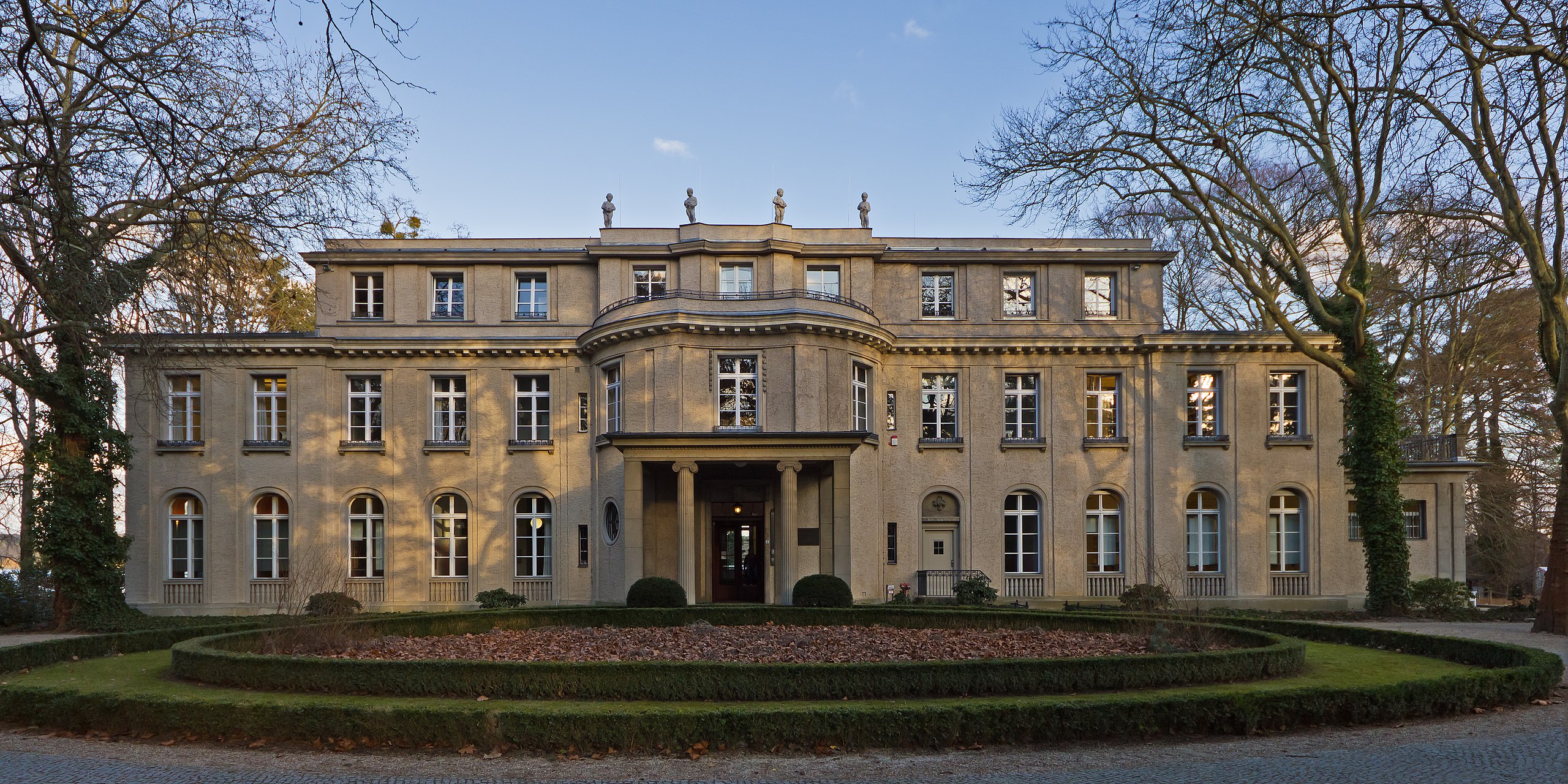
The villa Am Großen Wannsee 56–58, where the Wannsee Conference was held, is now a memorial and museum. (or A.Savin)
On January 20, 1942, 15 high-ranking Nazi officials sat down at a luxury villa to implement a genocide – the murder of eleven million Jews residing in 34 countries throughout Europe.
The gathering, known as the infamous Wannsee Conference, was held in an affluent suburb of Berlin. In the Nuremberg Trials that followed WWII, American prosecutors described the minutes from this meeting as “perhaps the most shameful document of modern history.”
As noted scholar Mark Roseman, general editor of the Cambridge History of the Holocaust and Professor of History at Indiana University, observed: “Here in the refined atmosphere of an elegant villa, in a cultivated suburb in one of Europe’s most sophisticated capitals, fifteen educated, civilized bureaucrats from an educated, civilized society sat about observing all due decorum. And here they gave the nod to genocide.”
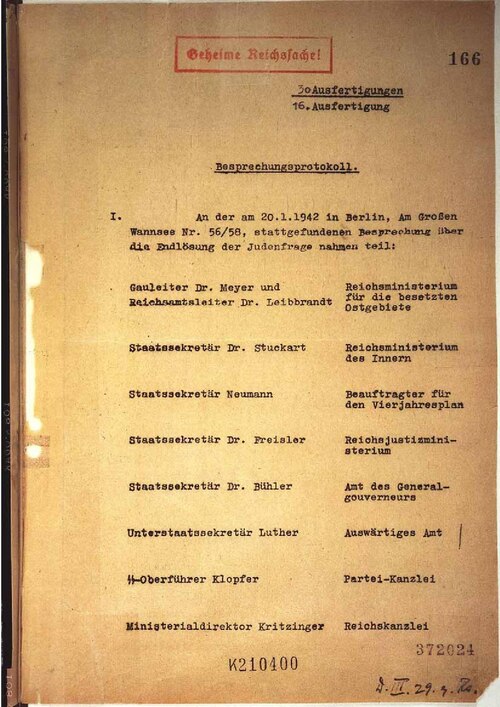
Minutes of the Wannsee Conference – Berlin, 20 January 1942. (Reich Main Security Office)
Chaired by Reinhard Heydrich, one of the principal architects of the Holocaust, the Wannsee Conference mapped out detailed extermination plans for the Jewish people. During the meeting Dr Josef Bühler urged Heydrich to begin the proposed “final solution to the Jewish question”.
After June of 1941, when the Germany invaded the Soviet Union (Operation Barbarossa), the Nazis had already begun escalating the process of the mass murder of Jews. Mass shootings of Jews by mobile killing squads (Einsatzgruppen) occurred all across this newly conquered territory, in what was later to become known as the “Holocaust by Bullets”. Ultimately 1 million Jews were murdered this way by the end of the war.
But the Einsatzgruppen method was viewed by the Germans as too slow, inefficient and costly. Further, it sometimes exacted a heavy toll on the executioners. The mass murders were also difficult to hide from the local populations.
Thus the Wannsee Conference was about how to implement the Final Solution in the most efficient and systematic way.
The minutes of the Wannsee Conference record that: “Due to the war, the emigration plan has been replaced with deportation of the Jews to the east, in accordance with the Führer’s will.” This was, of course, a euphemism for the deportation of the Jews to Hitler’s death camps.
As a result of the Wannsee Conference, a web of death camps was established in which millions of Jews were murdered from 1942 onward.
After the Wannsee Conference, until the end of the WWII, the “Final Solution” was the overarching goal of Nazi Germany – as they single-handedly pursued their goal of total extermination of Europe’s Jews.
It is of great import to point out that almost half of the 15 high-ranking Nazi officials who attended the Wannsee Conference held PhDs or advanced law degrees, a grim testament to the failure of Germany’s educational system to impart critical moral and ethical values.
“Education itself is not enough”, noted Scott Saunders, CEO of International March of the Living. “Pre-war Germany was one of the most educated societies in the world. And the decisions made at the Wannsee Conference itself, were taken by individuals with advanced degrees in higher education. What is critically important is the type of education being imparted, one that stresses the infinite dignity of every single human being: the Jewish people included. That kind of education was sorely lacking then and even today on many university campuses.”